Future Ready Cabonne: Increasing the Understanding
Upcoming Community Engagement
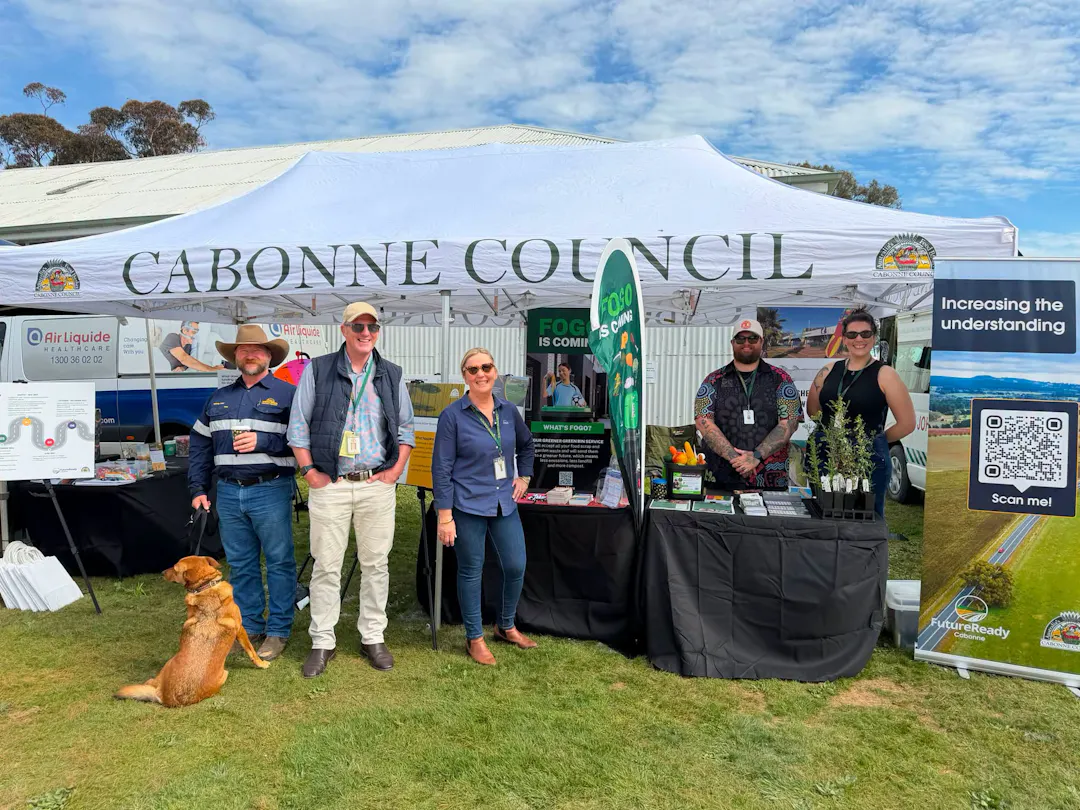
Council staff will be attending the Molong, Cudal, Eugowra and Canowindra Shows as part of our ongoing community engagement efforts to increase understanding of the Future Ready Cabonne initiative.
The shows provide a great opportunity to meet Council staff, learn more about the challenges and opportunities facing local government, and have a conversation about how Council can continue to deliver services, infrastructure and facilities that meet the needs of our communities into the future.
Members of Council's Environmental Services team will also be available to answer questions about waste and resource recovery, including the planned introduction of the Food Organics and Garden Organics (FOGO) service, which is scheduled to roll out across Cabonne in 2028.
You can find us under the Cabonne Council marquee between 10am and 2pm on the main show days. Whether you'd like to learn more about Future Ready Cabonne, discuss local issues, or find out how FOGO will work in your household, we encourage you to stop by, ask questions and have a chat with the team.
Show Days
Cudal Show - Sunday, 13 September
Eugowra Show - Saturday, 19 September
Canowindra Show - Saturday, 26 September
If you can't attend any of these days and would like to ask a question or provide feedback, please use the forum below or email council@cabonne.nsw.gov.au
Council has found it increasingly difficult to achieve financial sustainability and meet the integrated Planning and Reporting (IP&R) Guidelines.
Cabonne Council, like many rural and regional councils across New South Wales and Australia, is facing a structural financial sustainability challenge that cannot be resolved through short‑term measures alone. These challenges arise from long‑standing constraints on revenue growth, increasing service delivery costs, and the ongoing responsibility to maintain a large and ageing asset base in a geographically dispersed local government area.
Council’s audited financial results for the period 2021 to 2025, together with forward modelling in the Long‑Term Financial Plan (LTFP) 2026–2036, highlight persistent operating deficits before capital grants, asset renewal investment below sustainable benchmarks, and a growing funding gap under existing rate‑pegged revenue settings. Without intervention, these trends will continue to place pressure on Council’s financial capacity and its ability to maintain services and infrastructure at acceptable and equitable levels.
Why aren't council proceeding with making a decision regarding a Special Rate Variation proposal at this point in time?
At the time of preparing the business paper for the 28 April 2026 Ordinary Council Meeting, council was acutely aware of the significant upheaval and instability currently affecting global, national, and regional economies, largely driven by conflict in the Middle East and the resulting energy market shocks. At present, it remains unclear whether these impacts will be short‑term disruptions, medium‑term economic disturbances, or longer‑term structural challenges with potentially severe consequences.
Given this context of heightened and ongoing uncertainty, council chose not to proceed with an application to the NSW IPART in 2027 and postponed making this important decision regarding a Special Rate Variation (SRV) for a further eighteen months for a potential 2028 application to the NSW IPART. While council’s financial sustainability challenges are both serious and pressing, it is critical that council ensures the community has a clear and thorough understanding of the implications of both proceeding with an SRV or alternatively if council were not to pursue any rate increase. This includes the likely impacts on council’s medium- to long-term service levels and the condition of its assets. This would likely be extremely complex and difficult at the present time with such economic uncertainty.
Extending the consultation and information sharing phase over a longer period will assist in improving community understanding of council’s financial challenges. It will also provide council with greater capacity to balance its decision making against the currently unknown medium- to long-term economic impacts of the conflict in the Middle East. This includes consideration of council’s own ability to operate, maintain, and renew assets and deliver services during this period of economic uncertainty.
Integrated Planning and Reporting 2026-2027
The Integrated Planning and Reporting (IP&R) framework is prescribed by the Local Government Act 1993. The IP&R framework allows councils to draw its various plans together, to understand how they interact and inform each other, and to get maximum benefit from their efforts by planning holistically for the future.
At the 28 April 2026 Ordinary Council Meeting, council considered the Integrated Planning and Reporting 2026-27 documents, comprising of:
- Delivery Program 2025-2029,
- Operational Plan 2026-2027 incorporating the Budget and Fees and Charges, and
- Resourcing Strategy 2026-2036 incorporating the Long-Term Financial Plan, Strategic Asset Management Plan and Strategic Service Management Plan.
The Integrated Planning and Reporting 2026-2027 documentation were placed on public exhibition for 28 days. No submissions were received during this time, and the documents were adopted at the June Ordinary Council Meeting. The documents can now be viewed under the 'documents' heading and on Council's website.
How can I have my say on the Future Ready Cabonne: Increasing the Understanding project?
Make a submission via:
- Online: Use the Future Ready Forum below.
- Email: council@cabonne.nsw.gov.au(External link)
- Post: General Manager, PO Box 17 Molong NSW 2866
Any person may make written submissions to Cabonne Council about the project.
-
 Delivery Program 2025-2029 (revised 2026) (31.7 MB) (pdf)
-
Operational Plan 2026-2027 (51.7 MB) (pdf)
-
Resourcing Strategy Part 1 - Strategic Asset Management Plan 2026-2036 (12.7 MB) (pdf)
-
Resourcing Strategy Part 2 - Strategic Service Management Plans 2026-2036 (53.4 MB) (pdf)
-
Resourcing Strategy Part 3 - Long Term Financial Plan 2026-2036 (8.61 MB) (pdf)
-
Fees and Charges Report 2026-2027 (4.96 MB) (pdf)
-
Future Ready Cabonne - Financial Sustainability Plan (23.2 MB) (pdf)
-
Frequently Asked Questions - Future Ready Cabonne (2.98 MB) (pdf)
-
Information Sheet - Future Ready Cabonne (3.43 MB) (pdf)
-
Information Sheet - Long Term Financial Plan 2026-2036 (1.43 MB) (pdf)
-
Information Sheet - Review of Councils Rating System (1.38 MB) (pdf)
-
Information Sheet - Capacity to Pay (365 KB) (pdf)
-
Information Sheet - Financial Sustainability Plan (353 KB) (pdf)
-
Information Sheet - 2026-2027 Budget (1.05 MB) (pdf)

-
General Manager